Research Progress

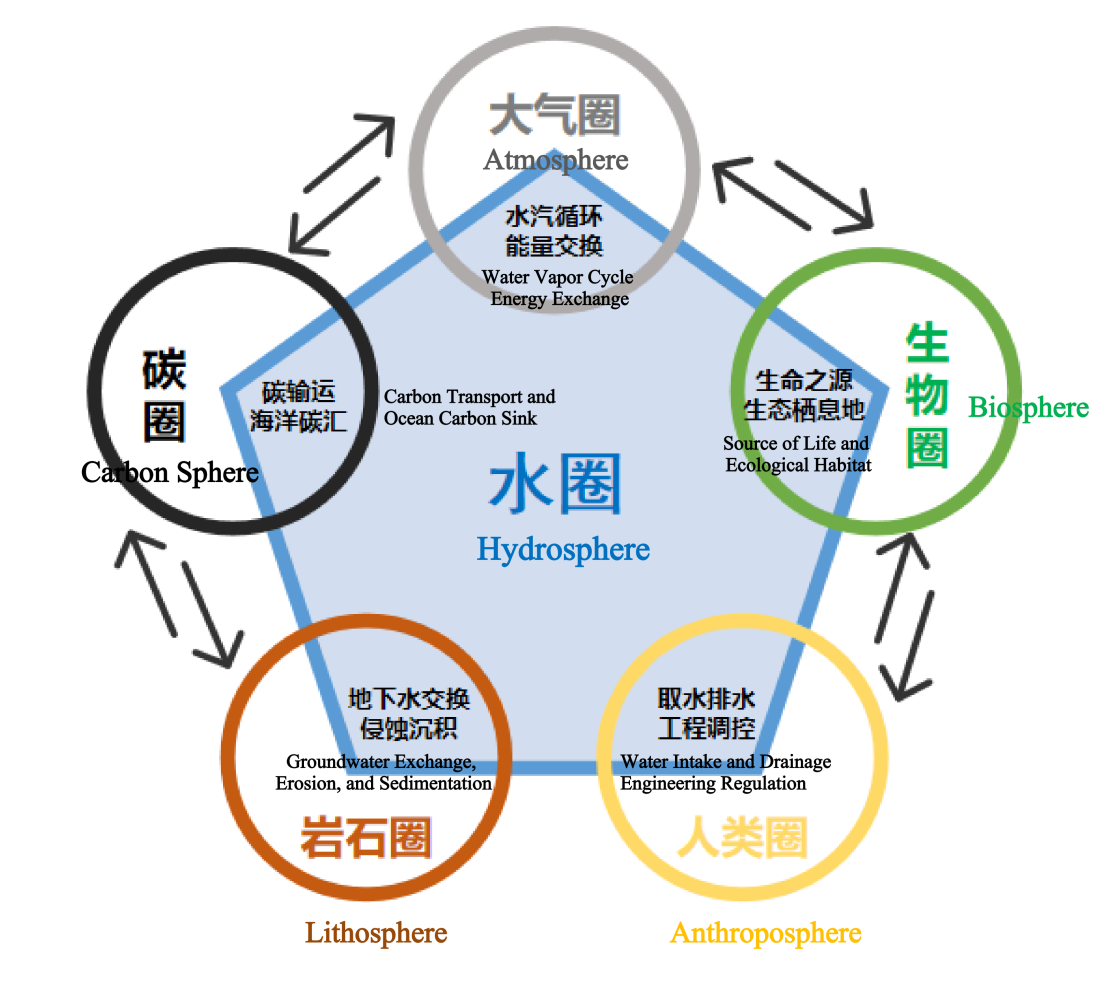
Theory of Hydrosphere

2025-10

Research Background: Mechanisms of Multisphere Coupling in the Earth System

From Parallel Disciplinary Approaches to Integrated Multidisciplinary Research

Hydrosphere Dynamics: Moving beyond static structures to quantitatively simulate hydrospheric processes for accurate prediction and management.

Hydrosphere Topology: From isolated water bodies to interconnected systems, revealing spatial structure, connectivity, and material transport pathways, providing a foundation for understanding the system dynamics.

Hydrosphere Informatics: Integrating remote sensing, artificial intelligence (AI), and big-data technologies to acquire, mine, and extract value from massive heterogeneous datasets, empowering intelligent decision-making.
Proposed the controllability principle of the hydrosphere system—the least constraint theorem—and revealed additional fundamental symmetries and novel conservation laws

Identified the existence of stable topological structures—atmospheric basins—from massive and complex atmospheric moisture source-sink relationships (AMSSRs)

Preliminary Findings: Based on the Eulerian atmospheric moisture tracking models, atmospheric basins—characterized by strong within-basin connectivity and weak cross-basin connectivity—were identified in complex atmospheric moisture source-sink networks

Open Questions: Do robust (model-insensitive) stable topological structures exist in massive and complex atmospheric moisture source-sink relationships (AMSSRs)? How sensitive are the identified structures to model choice?

Validated stable topological structures—atmospheric basins (ABs)—using a multi-model ensemble approach

Extracted global atmospheric moisture source-sink topological structures (AMSSRs)

Released the first global AMSSRAB dataset (AMSSRs and derived ABs) dataset based on a multi-model ensemble

Providing reliable data support for research on global hydrosphere structure

Zhang Y, Zhong D Y*, Cai R R, et al. A multi-model based dataset of global atmospheric moisture source-sink relationships and atmospheric basins [J]. Scientific Data, 2025, 12(1): 1842. https://doi.org/10.1038/s41597-025-06123-0

Developed an analysis framework linking upper-tropospheric precursor signals to the intensity and frequency distribution of extreme precipitation events

Taking the North China Plain as an example for analysis:

Ural blocking (UB) and Silk Road pattern (SRP) are the primary precursor processes for extreme precipitation

The SRP is more strongly associated with higher-intensity extreme precipitation events (EPEs) than UB

Zhang M X, Zhang Y, Li T J, Wang Y Q, Zhong, D Y*. Unveiling critical upper-tropospheric dynamics conducive to extreme precipitation over the North China Plain. Journal of Geophysical Research: Atmospheres, 2025, 130, e2025JD043902. https://doi.org/10.1029/2025JD043902

Developed a large model for the hydrosphere based on its topological structures to support water-resources management and disaster prevention and mitigation


Application: Strategic planning for major functional zones, including afforestation and greening, desertification control, carbon sequestration, energy development, and value enhancement