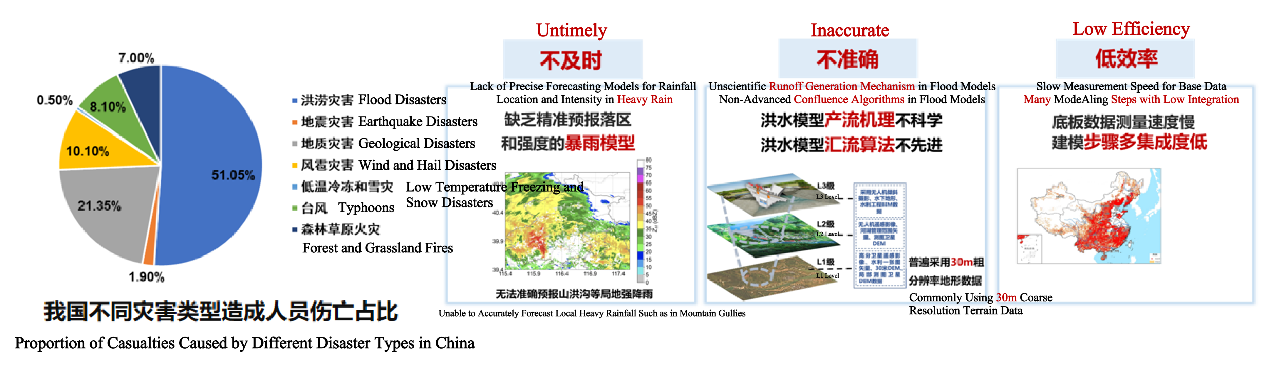
Research Background: Flood disasters are among the most frequent and damaging natural hazards worldwide. Precise and timely flood forecasting remains a key challenge, particularly in regions with complex terrain and limited observational data.
Current technologies suffer from issues such as untimeliness, inaccuracy, and inefficiency.
The key challenges include improving the accuracy of rainstorm area and intensity forecasts, refining the scientific mechanisms and computational efficiency of flood models, and enhancing modeling integration degree and operational efficiency.
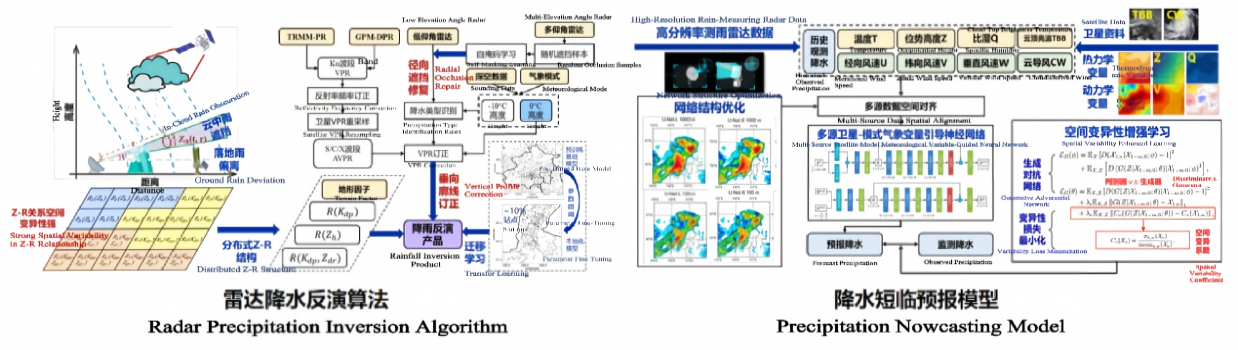
We developed AI algorithms for rainfall inversion and nowcasting, significantly improving transferability and forecast precision.
We developed a radar precipitation inversion algorithm integrating multi-source data, innovating radial occlusion repair and vertical profile correction algorithms, improving the accuracy and transferability of rainfall inversion.
We developed a deep learning model for precipitation nowcasting with enhanced spatiotemporal variability, addressing the forecasting challenges of precipitation cloud formation and dissipation processes.
The accuracy of radar precipitation inversion exceeds 85%, with a TS score of 0.44 for nowcasting at the 20mm/h threshold, representing a 16% improvement over existing technologies.
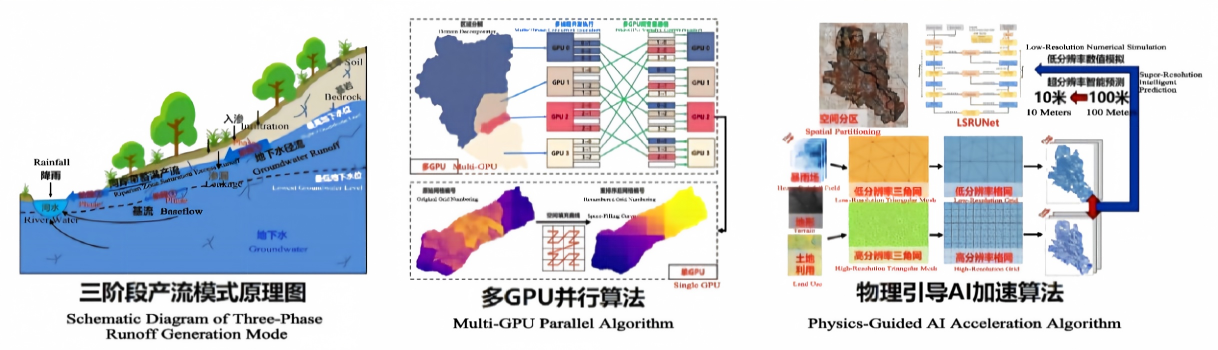
We established a comprehensive understanding of flood mechanisms and developed a highly intelligent and efficient flood model coupling hydrological and hydrodynamic modules.
Mechanism Enhancement: Based on long-term field experiments, we revealed flood mechanisms, establishing a complete understanding of regular patterns under different climatic and geological conditions.
Model Acceleration: We adopted full-domain 2D hydrological-hydrodynamic bottom-layer coupling, established multi-GPU parallel algorithms compatible with the topological structure of runoff generation and concentration, and physics-guided AI agent acceleration algorithms, achieving refined and efficient simulation of flood processes: With a 1-meter grid resolution and tens of millions of grid cells, the simulation time for a 24-hour flood process is less than 5 minutes.
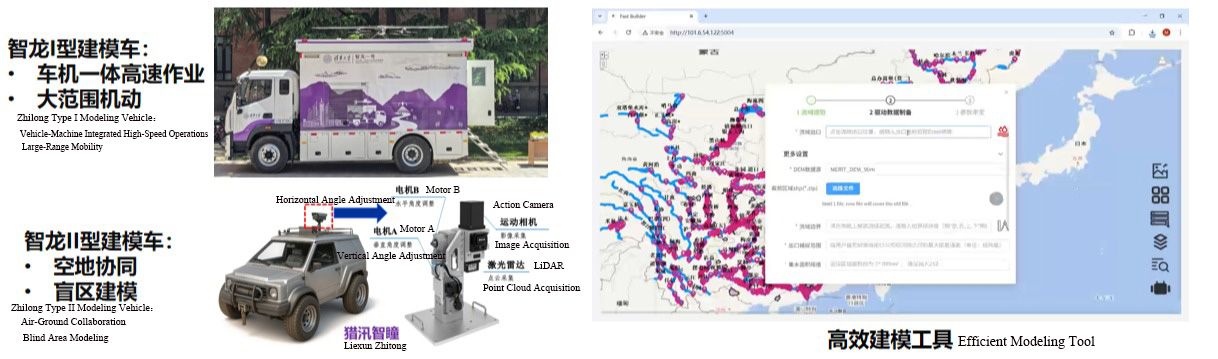
We developed integrated vehicle-drone and air-ground collaborative intelligent flood modeling equipment, significantly improving operational efficiency.
Vehicle-Drone Integration: Vehicle-mounted takeoff and landing platform enables efficient vehicle-drone collaborative operations, supporting emergency scenarios involving road disruption, power outage, and network failure.
Air-Ground Collaboration: Multi-modal sensing devices automatically extract features such as stormwater inlets, suitable for drone no-fly zones and modeling in monitoring blind areas.
Efficient Modeling: We integrated drones, sensing devices, intelligent algorithms, and forecasting models to complete the full process of measurement-transmission-modeling-calculation-visualization for areas of 200 km² in a single day.
Application of Achievements
The technology and equipment provide strong technical support for flood disaster defense command and scheduling, with significant social benefits.
The technology and equipment have been implemented in Beijing, Fujian Province, and Chengdu City.
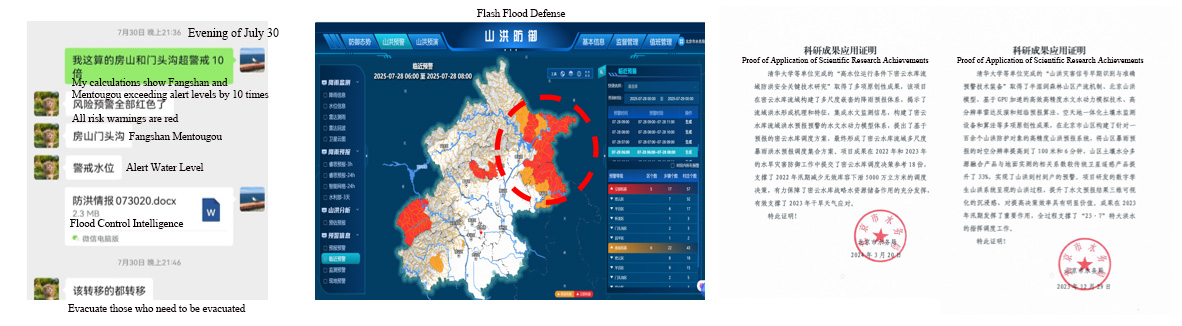
We fully participated in the defense against the “23·7” mega-flood in the Haihe River Basin, achieving flash flood warnings down to the village and household level and submitting 14 flood control intelligence reports.
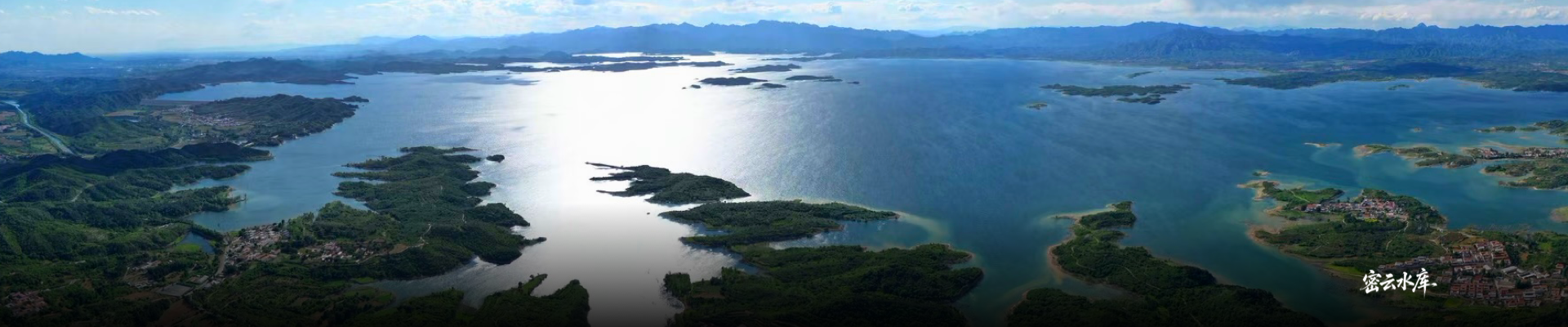
We supported flood control scheduling for Miyun Reservoir, achieving “safety assurance and maximum water storage” under mega-flood conditions.



 Achievement Links
 Administrator Mailbox